

What Is the Most Scratch-Resistant Leather for Bifold Wallets?
Table of Contents
- 1. Which leather types are least likely to show scratches?
- 1.1. Epsom-style, embossed, and crocodile surfaces
- 1.2. Smooth full-grain and vegetable-tanned surfaces
- 2. How should you choose a scratch-resistant bifold for daily carry?
- 3. What does scratch resistance mean for Wild & King bifold wallets?
- 4. How do you prevent and manage scratches on a leather wallet?
- 5. Conclusion
If you are looking for the most scratch-resistant leather for a bifold wallet, textured or embossed finishes are usually the top choice. Epsom-style leather and some crocodile surfaces are prime examples. Still, no leather is truly scratch-proof, and the finish, color, construction, and your care routine all shape how marks show up over time.

Which leather types are least likely to show scratches?
It helps to separate two ideas that often get mixed together. Some leathers genuinely resist marks because of their surface structure or finish. Others simply hide light scuffs because their texture breaks up the way light hits the surface. Both can leave you with a wallet that keeps looking presentable, but they get there in different ways.
Smooth leathers tend to display fine scratches more clearly because there is nothing to distract the eye. A textured or embossed grain, on the other hand, blends minor marks into the pattern. That is why many people who want a consistent look over years of daily carry lean toward leathers with visible structure.

Here is a compact comparison to make the trade-offs easier to see.
| Leather type | Visible scratch resistance | Surface character | Aging / patina | Maintenance | Daily bifold use |
| Epsom-style or embossed | Often good at hiding light marks | Fine, uniform pressed grain | Minimal change, stays consistent | Generally easy to wipe | Practical for steady appearance |
| Crocodile | Scale pattern can disguise some marks | Distinctive, bold texture | Can deepen depending on finish | Gentle care advised | Suits a statement bifold |
| Smooth full-grain | Shows marks more readily | Natural, refined | Develops rich patina | Occasional conditioning | Great if you welcome character |
| Vegetable-tanned / Pueblo-style | Marks and tones shift visibly | Rustic, organic | Pronounced patina over time | Simple, natural care | Good for an evolving look |
Use this as a guide, not a strict ranking. The exact finish and color on a given wallet can shift where it falls.
Epsom-style, embossed, and crocodile surfaces
Epsom-style leather has a fine, pressed grain that stays fairly uniform. That structure often helps light scuffs disappear into the surface instead of standing out. It also tends to keep a clean, consistent look, which appeals to anyone who does not want their wallet to change much over the years.

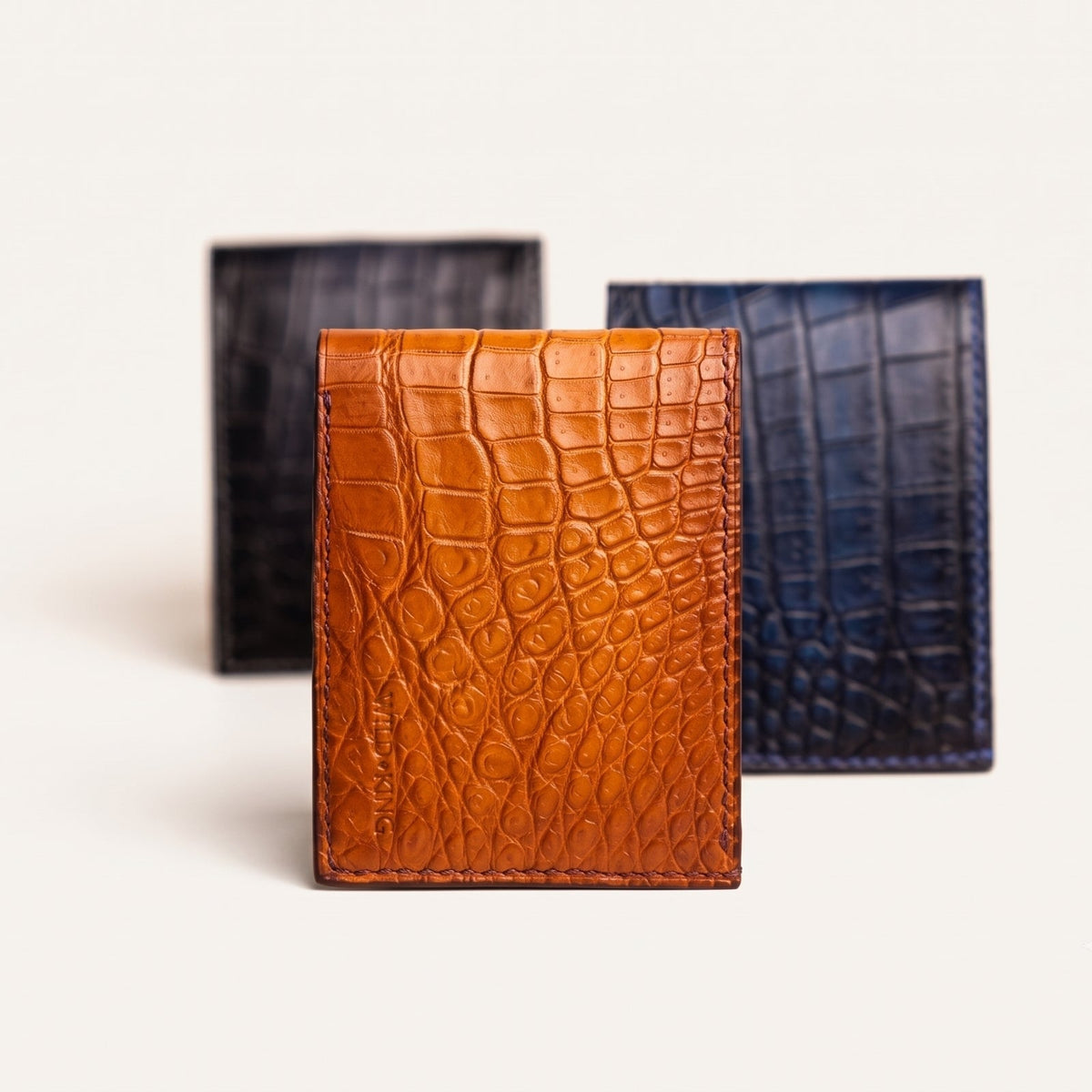
Crocodile/Alligator leather works in a similar way through its natural scale pattern. The raised and recessed scales break up the surface, so a small mark is less likely to catch your eye. This is not the same as being immune to scratches. Deeper contact, sharp objects, or rough handling can still leave a trace. The pattern simply makes many everyday marks harder to notice.

Smooth full-grain and vegetable-tanned surfaces
Smooth full-grain and vegetable-tanned leathers move in the opposite direction. Their natural, open surfaces can show scuffs, scratches, and tone changes more clearly. For some shoppers that is a drawback. For others it is the whole point.
These leathers often develop a patina that reflects how you use them. Marks blend into a deeper, richer look rather than reading as damage. It is worth remembering that visible wear on quality full-grain leather does not mean the wallet is failing. A surface that shows character can still be strong and long-lasting.
How should you choose a scratch-resistant bifold for daily carry?
Start with your priority. If you want the surface to stay looking the same, a textured or embossed leather is usually the safer pick. If you like the idea of a wallet that ages and tells a story, natural full-grain or vegetable-tanned leather may suit you better even though it shows more marks.

Color matters too. High-contrast finishes can make a scuff stand out, while mid-tones and patterned surfaces tend to blur them. If you are torn between two options, the darker or more textured one will often hide daily wear more forgivingly.
Do not judge a wallet by its leather alone. Construction, edge finishing, and stitching all affect how well it holds up. Card capacity is just as important. Pick a format that matches what you actually carry, and browse the full range of bifold formats and capacities before deciding. Overfilling a wallet puts pressure on slots and edges, which can distort the shape and create wear that has nothing to do with the leather type.
What does scratch resistance mean for Wild & King bifold wallets?
Wild & King offers a crocodile line for shoppers who want a textured, visually distinctive bifold. You can explore the minimalist crocodile bifold category to see the overall style and how it fits a slim everyday carry.
Within that line, the Square Shape Crocodile Leather Bifold Wallet collection is crafted from crocodile leather paired with Epsom leather. As one example, the green crocodile bifold with a patina finish blends both materials in a single design. It is described as holding up to six cards along with a full-size compartment for cash.
That pairing is a natural fit for this topic. The crocodile exterior brings a scale pattern that can help disguise light marks, while the Epsom leather offers a fine, uniform grain. This does not mean the wallet cannot scratch. No leather is fully scratch-proof, and not every Wild & King bifold shares the same materials or capacity. Treat this as one specific option rather than a universal claim.
How do you prevent and manage scratches on a leather wallet?
A few simple habits go a long way toward keeping any leather bifold looking its best.
- Keep the wallet away from keys, coins, and other abrasive items in your pocket or bag.
- Avoid overstuffing, since pressure stresses the leather and stitching.
- Wipe surface dust gently with a soft, dry cloth.
- Check the maker's care instructions before applying any conditioner or balm.
- Skip heat, hard rubbing, and unverified household cleaners, which can do more harm than good.
- Accept that some marks may simply become part of the leather's character over time.
For readers who want a wider view on how construction and materials affect longevity, this guide on durable bifold wallets offers helpful background beyond the question of visible scratches.
Conclusion
To settle a few common questions: full-grain leather is not scratch-proof, since the term describes the retained grain rather than immunity from marks, and a smooth full-grain surface may show scratches clearly depending on the finish and color.
Crocodile leather can also scratch. Its natural scale pattern may make some minor marks less obvious, but handling and finish still matter. And a textured wallet is not automatically better, because the underlying leather, finish, construction, and care routine all remain important.
If your main goal is a textured, visually striking bifold that shrugs off many everyday marks, Wild & King's crocodile options are worth a look. If you prefer a leather that ages and softens with use, compare the broader bifold range and choose based on surface character, capacity, and how much care you want to give it.

Leave a comment
This site is protected by hCaptcha and the hCaptcha Privacy Policy and Terms of Service apply.